










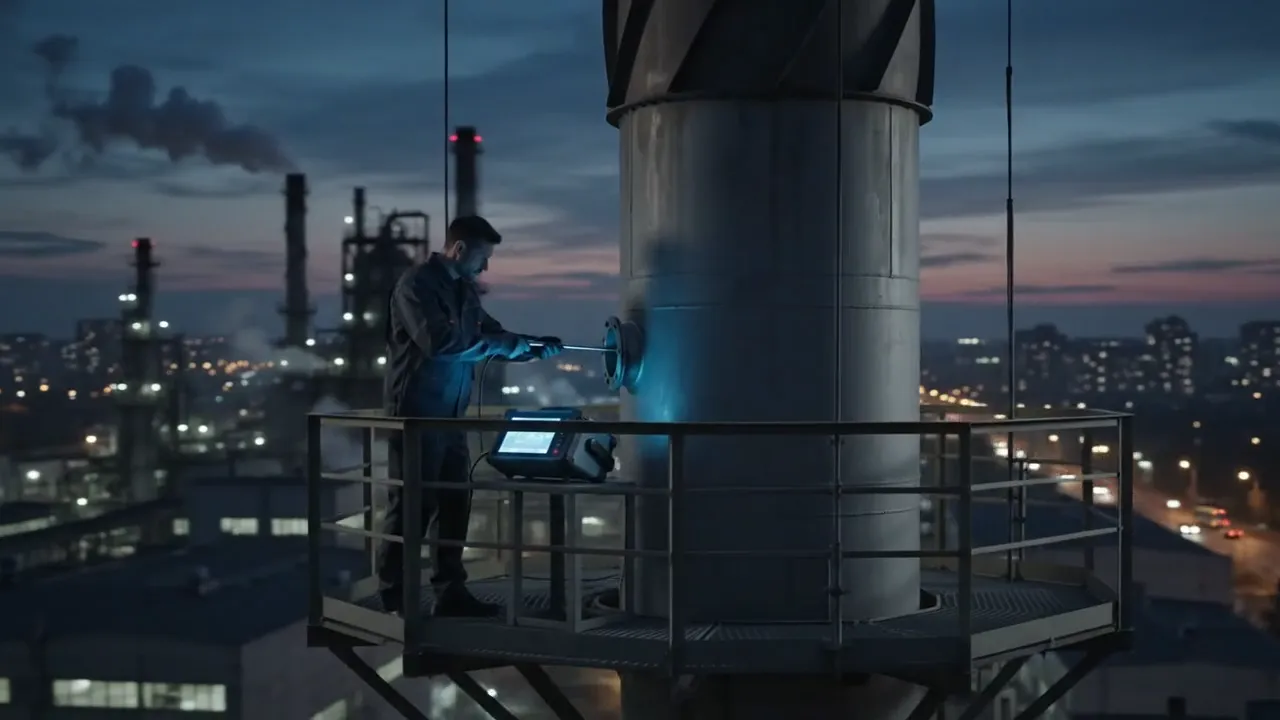
Maintaining traceability between KESA calculations and chimney inspection records does not mean merging them into one file. Keep the source, version, responsible person, time, file hash and revision links under shared chimney and job identifiers.
Why are a KESA calculation and an inspection record separate records?
A KESA calculation records the engineering calculation; an inspection record documents the asset, field observations and technical review. The existence of one does not prove that the other is current or correct.
Kesa Technische Software describes kesa-aladin as software for calculating chimneys and flue systems to European standards. Field inspection records serve a different purpose: they document the actual asset and inspection evidence. Link the two through the same facility, building, appliance and chimney identifiers while keeping their distinct roles clear.
In the VizyonTech workflow, keep the KESA source file and calculation output as separate records, and link the field form, measurement evidence and review status to the same job. A shared identifier establishes the relationship without replacing the original records.
Which fields should be kept for each record?
Short answer: more than the file name is needed. A minimum data dictionary should be used that makes it possible to find the source again, explain changes, and trace the value in the report backwards.
| Record group | Mandatory fields | Control outcome |
|---|---|---|
| Common identity | Facility/building, work order, chimney code, heater or device identity | The two sources are linked to the correct physical chimney |
| KESA source | Original source file, file hash, software version, calculation date, prepared by | It is visible in which source and environment the output was produced |
| Calculation output | Output file, output hash, controlled method/standard reference, technical reviewer | The link between the source and the published result is preserved |
| Inspection record | Record reference, status, recording time, operator, evidence file or verification record | Inspection status and the latest review time remain visible |
| Revision | Old-new version linkage, reason for change, affected fields, approved by | Silent overwriting is prevented |
A hash is a technical digest used to check whether the content of a file has changed; it does not by itself prove that the document is correct or authorized. Authorization, technical review and source verification must be performed separately.
What should be verified when a KESA file is taken into the system?
Short answer: transfer is not merely a file upload. The record must not be accepted before the file's source, format, integrity, software version and correct chimney identity are verified.
The KESA manufacturer explains that the software and the technical data it contains can be updated. For this reason, storing only the result PDF can make it invisible in which software and data environment the calculation was produced. The source file and the human-readable output should be kept together; the program version used when the calculation was created should be recorded.
- Verify the file extension and content type against an allow-list; do not trust the file name.
- Produce an integrity digest such as SHA-256 for the source file and use it for later change checks.
- Record the KESA software version, calculation date and the authorized person who prepared the calculation.
- Compare the project/chimney definition in the file with the facility, device and chimney identity in the work order.
- Store the source file and the calculation output under the same revision number, but as separate objects.
VizyonTech does not automatically guarantee the accuracy of a KESA calculation or the official acceptance of a record. The software's task is to make the check performed by the authorized person and the evidence they used visible and traceable backwards.
How should an inspection record be linked to its KESA calculation?
Short answer: matching must be done not by file name but via common physical asset identities and a verified cross-reference.
Store the inspection reference, record creation time, responsible person, review time and review status in separate fields. Screenshots may support the evidence, but the reference and verification record must also be stored as structured data. The review must be performed by an authorized person against the actual source evidence.
- First check the facility/building, heater and chimney code match.
- Display the KESA calculation revision alongside the inspection record review time.
- If there are differences in critical fields such as diameter, height, device or route, open an inspection task instead of closing automatically.
- Record a new inspection status as a timestamped event instead of overwriting the previous state.
- If a source file or inspection evidence is unavailable, keep verification pending; do not present an old record as newly verified.
How is the revision chain preserved when something changes?
Short answer: a new calculation or record must not delete the old version. The reason for the change, the report fields it affects and the re-approval requirement must be kept in an explicit event chain.
If appliance output, chimney height, diameter, material or route changes, record the new field data first. Create a new KESA revision and retain the previous file as read-only. Compare critical fields and assign any necessary reassessment of the inspection record to an authorized reviewer. Release the final report only after the current revisions have passed technical review.
| Gate | Evidence | Behavior on missing data |
|---|---|---|
| Identity match | Job, building, heater and chimney identity | Quarantine the transfer |
| Source integrity | Source file, hash, KESA version and preparer | Do not accept the calculation revision |
| Inspection record review | Inspection reference, status and review time | Hold technical closure |
| Difference review | Critical field comparison and justification | Open an approval task |
| Report publication | Current revision linkage and authorized technical approval | Block publication |
How should authorization, backup and data integrity be handled?
Short answer: traceability is not only a history screen; who can see and change what, how changes are recorded, and how a record is restored must also be controlled.
According to ISO's page, the third edition of ISO/IEC 17025:2017 was reconfirmed in 2023 and is the current framework for laboratory competence and consistent operation. TÜRKAK's LIMS information guide also addresses laboratory information management systems within the standard's information management context. The technical outcome: role-based access, immutable event trail, controlled correction, backup and restore tests must be built into the process design.
The person who uploads the raw file should not technically approve their own record; the preparer, reviewer and publisher roles should be separated as needed. If a correction is required, the old value, new value, reason, time and user are recorded. Rather than assuming a backup was taken, evidence is produced with a restore test.
Applicable short checklist
All seven checks below should pass before the calculation and inspection record chain is ready for reporting.
- Give each chimney a stable master identity; do not use the project name instead of an identity.
- Link the KESA source file, its output, its version and its hash to the same calculation revision.
- Store the inspection reference, status, review time and reviewer in separate fields.
- Compare critical field data between the two records and manage differences with tasks.
- Do not delete old versions; explicitly link the new revision to the previous one.
- Set up authorization gates for the preparer, reviewer and publisher roles.
- Prevent report release when source evidence is missing, differences remain unexplained or verification is pending.
Explore the solution scope and discuss identifiers, revisions and approval controls for your KESA and chimney inspection workflow. Vizyon Baca · Request a Demo.
Sources
- The Software: kesa-aladin — Kesa Technische Software GmbH, accessed 18 July 2026
- Software maintenance and current technical data statement — Kesa Technische Software GmbH, accessed 18 July 2026
- ISO/IEC 17025:2017, third edition; reaffirmed in 2023 — International Organization for Standardization
- Laboratory Information Management Systems (LIMS) Information Guide — TÜRKAK