









Short answer: how is the evidence link with the report preserved?
Give each film and original measurement file an immutable evidence identity; record the integrity digest, method context, and the linked report revision. A new report must not overwrite the old evidence.
An archive is not a folder where PDF reports sit. You must be able to reconstruct on which part, with which method and device, a finding was produced; where the original film or measurement file is; and with which review decision it entered the report.
How should the archive's data backbone be built?
Short answer: do not use the file name as an identity. Create separate, immutable identities for the work order, inspection point, evidence object, and report revision.
- Pin the inspection scope: record the part/equipment, weld or zone, method, technique, acceptance criterion, and work order identity.
- Open the evidence object: record the physical film, digital radiography, UT original file, device export, or field photo with its type.
- Keep the original immutable: do not edit the uploaded raw file in place; produce the viewing copy and annotated derivative as new versions.
- Record integrity: generate a cryptographic digest when the file is taken; re-verify after copying and restoration.
- Version the report link: each report revision must show the evidence versions it used with separate relationship records; previous links must be retained.
- Put a closing gate in place: if mandatory raw evidence, metadata, technical review, or integrity verification is missing, the report must not be published.
Which fields should each evidence record contain?
The common core is identity, source, technical context, time, integrity, and responsibility. Method-specific fields are added to this core.
| Record field | Question it answers | Risk if missing |
|---|---|---|
| Evidence identity and type | Is this object a film, an original measurement, or a derivative? | Original and copy get confused |
| Job/part/inspection point | Where and in which scope was the evidence produced? | It gets linked to the wrong part |
| Method and technique parameters | How should the data be interpreted? | The result cannot be re-evaluated |
| Device, probe, and personnel | Who produced it, with which hardware? | The technical trace is broken |
| Acquisition time and source system | When and from where did the original data come? | The chronology becomes ambiguous |
| File format, size, and digest | Is the file the same and openable? | Changes go unnoticed |
| Report revision relationship | Which report version used this evidence? | The result-evidence link is broken |
| Reviewer, decision, and time | How was the evidence evaluated? | The technical decision cannot be explained |
How should a physical NDT film be archived?
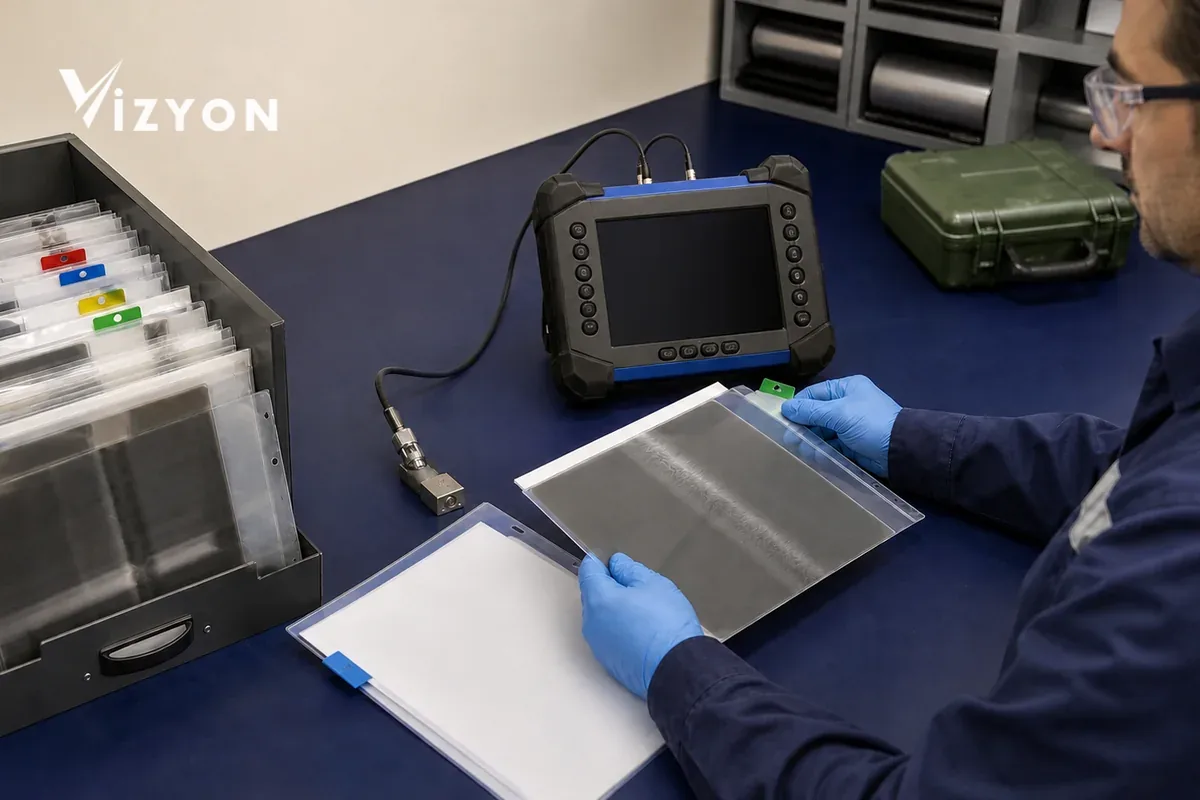
For a physical film, a digital record does not replace the film itself; it manages its location and status. ASTM E1254-13(2023) offers a storage guide for the control and care of industrial radiographs and unexposed films. The guide does not decide whether a part is acceptable; this boundary is important.
Match each film envelope with an evidence identity; record the depot, cabinet, shelf, and envelope location. Manage receipt, lending, return, and status checks with an audit trail. Do not generalize numeric rules such as temperature, humidity, light, or retention time; take them from your organization's film system, contracts, applicable standards, and approved procedures.
Scanning the film can make access easier, but the scan is a derivative. The decision to destroy the physical original must not be given automatically without evaluating the contract, legislation, customer requirements, and the institution's retention plan.
Why is a digital measurement file more than a screenshot?
Short answer: a screenshot only carries the view; the original file can preserve the technical parameters and data structure needed to reopen the measurement.
ASTM E2339-21 aims to have different NDE images and signals organized in a common format together with their method parameters via DICONDE. ASTM E3267-21 addresses the archive information model for storing and retrieving this data. Specifically for UT, the current ASTM E2663-25 describes storing ultrasonic parameters and results in a standard structure against the long-term analysis and archival problems of proprietary formats.
The technical counterpart is this: keep the device's original export; record the DICONDE copy, if any, as a separate derivative; document the software/version used for conversion and its validation result. A waveform pasted into a PDF does not automatically substitute for the original file.
What happens to the evidence when the report is revised?
The evidence is not modified in place. A new interpretation, annotated image, or reprocessed output is a new derivative version; from which original, with which tool, and for what reason it was produced is recorded.
- The published report R1 is locked with the evidence identities and versions it used.
- When a correction is needed, an R2 draft is opened; R1 and its links remain visible.
- If new evidence arrives, a new object is created; if there is a re-interpretation, a new review decision is created.
- R2 explicitly lists the old and new evidence versions it uses.
- Integrity, authorization, and technical review are re-verified before publication.
This approach makes it easy to find the latest version of the report while also preserving which evidence the past decision was based on. e-signed report revision and audit trail guide details the version chain on the report side.
How are integrity, backup, and access tested?
NIST IR 8387 emphasizes that digital data is easily altered and that protection carries risks different from physical media. In an NDT archive, this principle can be implemented as keeping the original object immutable, authorized access, logged operations, integrity checking, and verified restoration.
- Keep the digest algorithm and its generation time in the evidence metadata; do not use the digest in place of the file name.
- Separate the roles of the original, the viewing copy, and the annotated derivative.
- Do not leave deletion and retention decisions to a single user action; require authorization and justification.
- Test not only that backups occur but that they can be restored by sampling and that relationships are preserved.
- If a file does not open, the digest does not match, or a report link is missing, do not show the record as reliable; put it into the review queue.
Which scenarios should be tested in a VizyonTech pilot?
Vizyon Periyodik or when evaluating a VizyonTech solution adapted to your NDT/DT workflow, choose a single real but anonymized inspection family. Set up end to end the physical film location, the UT original file, the device-personnel link, technical review, and two report revisions.
In the pilot, try these negative scenarios: two files with the same name, a changed file digest, a lost physical film, an unopenable proprietary measurement, evidence linked to the wrong part, an R2 attempting to silently change R1's evidence, and a failed restoration. The success criterion is not just the file being uploaded but the system verifying the link, stopping the report when something is missing, and preserving the correction history. To design the method report fields together, also use the VT, PT, MT, UT, and RT report management guide.
Sources
- ASTM International — E1254-13(2023), Storage of Radiographs and Unexposed Industrial Radiographic Films (current version; accessed: 12 August 2026).
- ASTM International — E2339-21, Digital Imaging and Communication in Nondestructive Evaluation (DICONDE) (current version; accessed: 12 August 2026).
- ASTM International — E3267-21, Building Information Models and Archiving for DICONDE (current version; accessed: 12 August 2026).
- ASTM International — E2663-25, DICONDE for Ultrasonic Test Methods (15 July 2025; accessed: 12 August 2026).
- NIST — NIST IR 8387, Digital Evidence Preservation: Considerations for Evidence Handlers (September 2022; accessed: 12 August 2026).
The retention period, storage conditions, file format, and acceptance criteria to be applied should be determined by authorized persons based on the contract, method standard, customer requirements, and the organization's approved procedures.