











The periodic inspection plan should take each piece of equipment into inventory with a unique identity and record the basis for scope and period, calculate the next inspection and, when the time comes, produce a work order that verifies competency and field conditions.
A good plan is not merely a list of upcoming dates. It is a chain of decisions showing which asset was included in scope and why, according to which rule the date was calculated, who did what in case of change, and with which evidence the task was closed.
Which records make up the backbone of the plan?
Short answer: a reliable equipment master record, a versioned period rule and a work order derived from these two are required. If these three layers are not separated, a serial number change, relocation of equipment or a legislative update makes past records ambiguous.
1. Establish the equipment inventory as unique and verifiable
Give each asset a unique identity. At a minimum, the equipment group, brand-model, serial number, year of manufacture, facility and open location, purpose of use, capacity or distinguishing technical characteristic, and commissioning and decommissioning status should be kept. Keeping the manufacturer's label and the organization's internal code in separate fields prevents differences in the spelling of the same serial number from appearing as two assets.
The ÇSGB's Annex-III explanation dated 2025 requires the equipment label information and traceable technical characteristics to be included in the report. For this reason, the initial record of the plan should not be free text that the field team will rewrite at the report stage; it should be the verified equipment card.
- Identity: internal asset code, manufacturer serial number and, if any, label photograph.
- Context: facility, section, location, responsible unit and usage status.
- Classification: equipment group, sub-type and inspection scope.
- Change trace: relocation, major maintenance-repair, capacity or usage change.
During inventory cleanup, do not blindly merge duplicate cards. A merge made without verifying the serial number, location and past report link can break the evidence chain.
2. Separate the scope decision from the period decision
First answer the question “Is this asset within the scope of mandatory periodic inspection?”, then the question “Which duration or event rule applies?”. According to the ÇSGB's 23 December 2025 amendment summary, only the equipment or equipment groups in the Annex-III tables are within the scope of mandatory periodic inspection. It is possible for the organization to request additional inspections for maintenance, insurance or risk management purposes; however, the basis for this must not be presented as a legal obligation.
The following fields should be visible in every plan rule: basis type, document name and version, relevant article or table, validity start, calculation method, approving role and reason for change. Thus an old work order is not silently recalculated with a rule that changed later.
How is the inspection period determined?
Short answer: the current official criterion or standard applicable to the equipment type is taken as the basis; if there is no suitable basis, the sequencing and risk assessment defined in the regulation are documented. A plan is not built on a single “every equipment once a year” assumption.
The period engine must manage two types of triggers together:
- Time trigger: the period calculated from the last valid inspection or a defined start date.
- Event trigger: initial installation, relocation, major maintenance-repair, an unusual event that may affect the safety of the equipment, or another change defined by the relevant rule.
The ÇSGB's official construction works FAQ explains that for some equipment, a re-inspection requirement may arise after an upgrade, modification, adverse weather conditions, long periods of non-use or relocation. The technical result is this: the plan engine must not only calculate “last date + duration”; it must also listen to asset events.
ISO 55001:2024 also highlights life cycle, performance and risk context in asset decisions. This standard does not give legal inspection periods for individual pieces of equipment; however, it is a useful management framework for the organization to establish scope, data and decision management systematically.
When should the plan turn into a work order?
Short answer: the task should be opened early enough to cover the preparation time; but before a definite field assignment is made, the scope, contract, method, personnel competency, measuring instruments and access conditions must be verified.
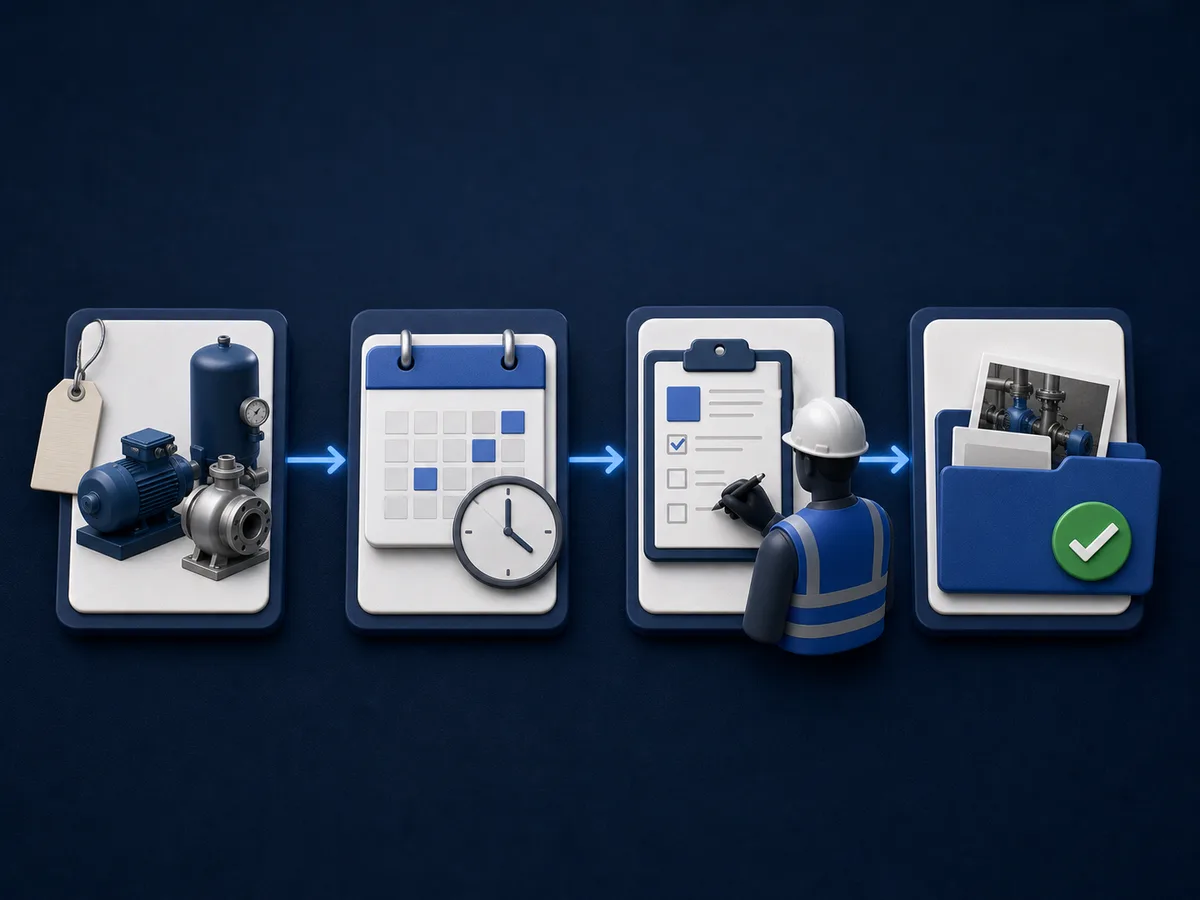
When the work order is opened, not a snapshot copy of the equipment card but the relevant asset identity and the rule version used should be linked. The order should carry the planned date range, facility-location, inspection scope, method source, competency to be assigned, required instrument group, field access notes and customer contact.
The status flow can be kept simple and auditable: draft → awaiting preparation → assigned → in field → under technical review → completed. If there is a missing contract, unsuitable personnel competency or an invalid measuring instrument, the system should not merely warn; it should stop the assignment or the field start according to the organization's approved rule.
When does the next inspection date become final?
Short answer: do not confuse the planned date with the actual date. The next date must be calculated according to the organization's approved rule over the valid inspection result and the relevant date field in the report; a cancelled or incomplete order must not be counted as the start of a new cycle.
The ÇSGB's current Annex-III explanation foresees that the start date of the next inspection to be carried out under normal conditions is included in the general report information. The plan engine can take over this field in a controlled manner after the report is published. If a manual change is required, the old value, the new value, the justification, the person doing it and the time stamp must be preserved.
Applicable checklist
Short answer: before going live, run an end-to-end rehearsal with a small but representative equipment group.
- Has every piece of equipment been verified with unique identity, serial number, location and status information?
- Have the basis and version of the scope decision and the period rule been recorded separately?
- Are event triggers such as installation, relocation and major maintenance defined alongside time?
- Is the work order opened within a suitable preparation time and is the formation of duplicate tasks prevented?
- Are personnel competency, method and required measuring instruments checked at the assignment gate?
- Do cancellation, postponement and manual date changes leave a trace with justification?
- Does completion occur only after a valid field record and technical review?
- Is the next date produced from the approved result rule instead of the planned visit?
How does VizyonTech meet this flow?
VizyonTech's periodic inspection software product page defines equipment inventory, inspection plan, mobile field record, QR access, report and e-signature steps within the same product scope. In an implementation evaluation, do not settle for the marketing list: using one of your organization's real equipment cards, its own period basis and competency rule, request a demo from work order to closure.
If you also want to see the end-to-end field and report chain you can also look at the guide to digitizing; to compare product selection gates to the periodic inspection software selection guide .
Sources
- Ministry of Labour and Social Security — 23 December 2025 Regulation amendment summary
- Ministry of Labour and Social Security — Health and Safety in the Use of Work Equipment
- Ministry of Labour and Social Security — Safe Construction frequently asked questions
- ISO — ISO 55001:2024 Asset management system requirements
- VizyonTech — Periodic Inspection Software product page