











What does it mean to digitize periodic inspection?
Digitizing periodic inspection means identifying each piece of equipment with a unique identity, tying contract and authorization checks to the work order, collecting field measurements at the source, locking technical approval and delivering the signed report with version history.
The goal is not to move a paper form onto a screen or to produce a PDF at the last step. The real transformation is being able to show which equipment was inspected, by whom, with which method and device, and when, in a single record chain. Every step of this chain must preserve both the basis of the technical decision and the trail for a later review.
First translate the regulation into a data model, not a form
A solid start is converting the information required in the official report into verifiable and versionable record fields rather than free-text boxes.
Before field work begins, confirm the applicable requirements, approved inspection scope, customer contract and current equipment-specific criteria. Record the form and procedure version used for each job so that the basis of a historical result remains traceable.
The software counterpart of this is to build the following control gates before any "report template":
| Control gate | Minimum context to keep in the system | Transition rule |
|---|---|---|
| Equipment scope | Equipment group, location, brand-model, serial number and technical identity | Field work does not start before the correct scope and current form are selected. |
| Contract | Contract reference, approval status, parties and approval date | A report must not proceed to release until the applicable contract and approval requirements have been met. |
| Competency | Inspector qualifications, authorized scope, relevant registration where required, and validity records | An assignment not matching the job's scope stops at the planning stage. |
| Method and device | Applied standard/criterion, device identity, calibration and intermediate verification status | An expired device, or one undefined for the job, cannot be linked to a field record. |
| Technical decision | Measurement, observation, evidence, defect degree, justification and the approving person | The report is not locked while a mandatory field is missing or an open technical check exists. |
| Publication | Report version, signature status, publication time and delivery channel | The approved version cannot be changed; a correction is opened as a new revision. |
For equipment types the Ministry has not published, the system must not automatically deem "a similar form" correct; it must clearly show the Regulation Annex III, the relevant standard and the manufacturer/risk assessment order to the technical manager. If the official criterion distinguishes minor and major defects, this classification can be carried into the workflow; if not, the software must not invent its own defect degrees. [1]
In what order should the digital flow from field to report be built?
The applicable order is inventory, contract, assignment, field evidence, technical review, controlled publication and follow-up of the next interval.
- One piece of equipment, one identity: Merge the names in the customer's separate Excel lists; uniquely identify equipment by serial number, location and internal code. QR or barcode is an operational access key, not a regulatory requirement.
- From contract to work order: Link the customer contract, authorized scope and approval evidence to the work order. An internal status label must not substitute for the approval or evidence required by the applicable procedure.
- Right person and right device: Personnel scope, EKİPNET information, device calibration and intermediate verification should be checked together. The planner should see not just an available person but the person competent for that job.
- Opening the correct form in the field: When the equipment identity is scanned, the current form matching the scope should open. A job started with an old form version must not be silently converted to the new version.
- Collecting evidence at the source: The measurement should be tied to the same record as the equipment, checkpoint, device, time, user and, if needed, photographs. Values copied later at a desk must not be treated with the same level of confidence as field records.
- Technical review and revision: A missing field, inconsistent measurement or unsupported result should return to the technical manager as a task. A change after approval creates a new revision; the previous version must not be lost.
- Signed delivery and the new interval: The final PDF should pass through the corporate signature workflow, the customer should access the current version with authorized access, and the next inspection date should start planning on the equipment card.
This order is also consistent with the basic record approach in the European Union's Directive 2009/104/EC on the use of work equipment: the results of checks carried out by competent persons must be recorded, kept for an appropriate period and made available to competent authorities. This source does not replace Türkiye's specific report format; it supports why the digital record must be traceable and accessible. [4]
When does field data become technical evidence?
A measurement becomes technical evidence only when it is stored not merely as a numeric value but together with the equipment, checkpoint, method, device, user, time and justified result.
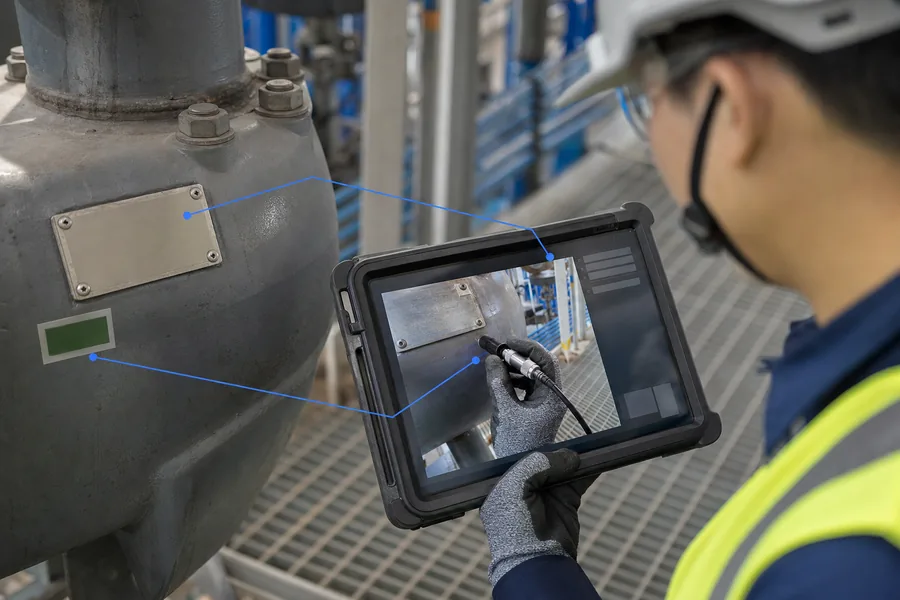
For example, the option "suitable" alone is a weak record. It must be visible which inspection criterion was applied, which value was read, what the acceptance limit was, and who reached the conclusion on what evidence. A photograph, too, should not be just a gallery attachment; it should be linked to the relevant checklist item, its capture time and uploading user preserved, and which image changed in a revision must be understandable.
ISO/IEC 17020:2026 is the current international framework for the competent, impartial and consistent operation of inspection bodies. ISO's official summary notes that the 2026 revision also contains new provisions on the control of data and information. For this reason, a digital system must produce not just fast data entry but controlled information, authorization and change trails. [2]
How do records stay safe at field sites without internet?
Offline operation is more than temporarily storing data on the device and sending it later; user, form version, time and conflict decisions must be protected.
Before starting a job, the mobile app should download only the assigned equipment and the required form version to the device. While the field record is created locally, every action should receive a unique identity and timestamp; on synchronization, the same record being edited by two people must not be left to a silent "last writer wins" rule.
- The form version and the work order version should be stored together.
- Deletion should produce an authorized cancellation/revision record instead of a physical delete.
- Conflicting measurements should drop into the technical review queue.
- A job must not be counted as "synchronized" before photo uploads complete.
- There must be a security policy that cuts local access when a device is lost or authorization is revoked.
This approach increases field speed while also letting the technical manager answer "which data came first?". The offline feature is not a marketing label but an auditable data lifecycle.
Can software make the technical decision automatically?
Software can produce limit, missing-field and inconsistency warnings; the final technical judgment and report signature must remain with the authorized person.
Automatic rules are valuable for catching an expired device, a missing contract, an unauthorized assignment, a measurement outside the acceptance limit or an incomplete checklist item. But generating the "suitable/not suitable" decision alone, detached from context, blurs the responsibility for impartiality and competence.
In the right design the rule engine does not decide; it generates a justified warning. The authorized person evaluates the warning and records their choice and rationale. If the technical manager reaches a different conclusion, this change appears in the revision history with identity, time and justification. The Ministry's announcement also clearly states that the report's result and judgment are formed by the authorized person's assessment and that unsigned reports are invalid. [1]
How does the 2026 ISO/IEC 17020 transition affect the digital system?
Forms, authorizations and procedures must be versionable; as the organization moves from the 2012 revision to 2026, which rule produced the older records must be preserved.
ISO published the third edition of ISO/IEC 17020 in March 2026. Under TÜRKAK's transition policy dated 15 June 2026, the 2012 and 2026 versions can be applied together during the transition period; accredited inspection bodies are expected to complete their preparations by 31 July 2027 and the transition to conclude by 27 March 2029. [2] [3]
This calendar shows why keeping a single "standard" text field in the system is insufficient. The form version, inspection criteria, authorization matrix and review step must be managed with their effective dates. When an old report is opened, the version used on the date that report was produced must appear, not today's rule.
How should personal data and field files be protected?
Limit authorization by role and customer scope, collect only the necessary data, log access, back up and tie the retention period to a written policy.
A periodic inspection record may contain personal data such as the authorized person's identity, workplace information, photographs, signatures and contact details. The KVKK's Personal Data Security Guide addresses appropriate technical and administrative measures to prevent unlawful processing and access and to ensure data safekeeping, under the headings of risk analysis, data minimization, access management, security monitoring, system maintenance and backup. [5]
- The planner, field personnel, technical manager and customer should not have the same authorizations.
- The customer user should see only their own organization and the locations they are authorized for.
- The activity log should show not just "logged in" but critical record changes.
- The retention period should be defined by legislation, contract and institutional policy, not by an "infinite archive" assumption.
- The result of a restore test should also be recorded, not just that a backup was taken.
How should the transition from paper to a digital process be planned?
First clean the data and rules, then run a pilot in a limited scope; expand the validated flow in a controlled manner.
1. Preparation: inventory and rule map
List the current customers, locations, equipment, personnel, devices, forms and reports. Match the different names of the same equipment; document the mandatory fields, authorization rules, standards used and the report numbering logic.
2. Pilot: one scope, a real field job
Choose a highly representative equipment group and a small field team. Evaluate success not by "how many forms were filled in" but by the number of missing records, revision reasons, offline sync accuracy, the approval cycle and the customer's access to the current report.
3. Rollout: version and change management
Rather than copying the validated form and flow to other scopes, review each equipment group's criteria separately. Provide user training by role; instead of applying the new version to all jobs at once, define a transition rule separating open jobs from new ones.
4. Operation: measurement and improvement
Delayed inspections, missing evidence, rejected reports, recurring revision reasons and devices approaching expiry should be reviewed regularly. The aim is not to score personnel but to see friction and risky gaps in the process early.
What are the most common digitalization mistakes?
The biggest mistakes are migrating scattered data without cleaning it, making everything free text, and updating post-approval changes without a trace.
- Treating the PDF as data: The final report matters; but the structured record that produces the report must also be preserved for search, tracking and audit.
- Treating QR as the solution: QR only leads to the correct equipment card. If the card is wrong, it quickly leads to wrong data.
- Giving every role full authorization: Broad permissions opened for speed blur the boundaries of technical decision-making and customer confidentiality.
- Imitating the official system: Treating an unverified contract or approval as complete solely because an internal checkbox is selected is a serious process error.
- Silently changing an old report: A correction must produce a justified new revision rather than destroying the old version.
- Applying one form to all equipment: Equipment type, standard and official criteria differences must be preserved in the form version.
How does Vizyon Periyodik meet this flow?
Vizyon Periyodik combines the equipment inventory, QR access to the correct record, the offline field form, device-competency checks, approval, the signed report and customer delivery on the same record.
On the Vizyon Periyodik product page the flow described covers the process from quotation and contract to the work order, from field measurement and photographs to technical checks, from report revision to the customer panel, on a single backbone. During setup, forms, roles, reports and integrations are tailored to the organization's real scope; no claim of "a ready template automatically complies with the regulation" is relied upon.
A good demo should not be a generic feature tour either. The end-to-end flow should be tested with an example from your own equipment list, your current report, your authorization matrix and an offline field scenario. When planning a process analysis with VizyonTech preparing these four inputs makes decision-making easier.
Frequently asked questions
Is Excel enough for periodic inspection tracking?
Excel can list a small inventory; but on its own it is not a controlled workflow for simultaneous field records, role separation, form versions, device validity, technical approval, revision trails and delivery of current reports.
Is a QR code on equipment mandatory?
No. QR must not be presented as a general requirement of periodic inspection regulation. It is an identification tool used to quickly reach the correct equipment card, past reports and the current form, for operational purposes.
Can an offline field record be changed afterwards?
An authorized correction may be possible; but the initial record, correction time, user and justification must be preserved. A synchronization conflict must not silently overwrite data; it should create a technical review or a controlled revision.
Does software guarantee regulatory compliance?
Software helps check mandatory fields, authorization, deadlines and approval gates. Compliance depends on the correct application of current regulations and criteria, the authorized person's technical assessment and the organization's controlled processes.
Sources
- Republic of Türkiye Ministry of Labour and Social Security — Work Equipment Regulation 23 December 2025 amendment announcement (24 December 2025).
- ISO — ISO/IEC 17020:2026, Conformity assessment — Requirements for bodies performing inspection (3rd edition, March 2026; corrected version June 2026).
- TÜRKAK — Announcement on the Transition Policy for the TS EN ISO 17020 Standard (15 June 2026).
- EUR-Lex — Directive 2009/104/EC, minimum safety and health requirements for the use of work equipment (16 September 2009, current consolidated source).
- Personal Data Protection Authority — Personal Data Security Guide (Technical and Administrative Measures).
Sources were checked on 10 July 2026. Because legislation, official criteria and standard transition schedules may change, current official texts must be re-verified before implementation.