











A good stack emission field plan; it verifies in a single record, before going to the field, the measurement scope, the correct stack and sampling point, the competent team, the appropriate instrument set, the process conditions and the safe work permits.
Why is a field plan not just a calendar entry?
Short answer: The plan should not only say where and when the measurement will be made; it should prove that the measurement method is applicable and that the team can work safely.
An appointment record consisting of facility name, date and team list does not close the technical uncertainties to be encountered in the field. The plan must link the facility, unit, process and stack identity; the measurement purpose and parameters; the selected method and version; the sampling plane; the process operating condition; the personnel, instrument and consumables set; and the access, energy and occupational safety conditions.
What is planned and what actually happens must also be separated. When weather, process, access, personnel or instruments change, instead of overwriting the old assignment, the time of change, the justification and the approval are kept. Thus the technical reviewer can trace under which field condition the result in the report was produced.
First, how are the scope and stack identity verified?
Short answer: The stack in the work orders, the physical source in the field and the sampling conditions in the measurement method must be matched under the same identity.
In the same facility there may be more than one source with similar names such as “boiler stack”. For this reason, facility and unit, process, fuel or raw material, stack code, location, diameter, number of ports, platform and access information must be kept together. Previous reports can be initial data; they must not be automatically accepted as correct without seeing the current geometry and field condition.
The U.S. Environmental Protection Agency's current Method 1 page requires that sample location and traverse points for representative measurement at stationary sources be determined within the method. This source does not replace the method to be applied in Türkiye; the technical result in terms of planning is as follows: the existence of a port is not sufficient on its own; the suitability of the selected method for the sampling plane and flow conditions must be assessed in advance by the competent technical team.
- Record the measurement purpose, the parameters and the reference conditions to be reported.
- Link the method to be applied, the controlled document name and the valid version to the job.
- Add survey evidence for the stack diameter, ports, straight duct distances and the access platform.
- Verify with the facility responsible person the expected operating state of the process during the measurement.
- If the method is not applicable, refer it to technical assessment instead of starting the job.
With which checks is the field team assigned?
Short answer: Not the person's name; the measurement or sampling duty, method competency, validity status, field role and safety training are checked together.
The Ministry of Environment, Urbanization and Climate Change's program dated 4 November 2025 regulates, under separate headings, reporting personnel and measurement and sampling trainings in the emission-immission field. This distinction supports duty-based assignment in software instead of giving everyone a single “active personnel” flag. The organization's scope of competence and its own authorization procedure must also be verified.
ISO/IEC 17025:2017 addresses laboratory activities, including sampling associated with subsequent testing, within a framework of competence and consistent operation; according to the ISO page, the third edition was reaffirmed in 2023. The technical result is that the team is selected not only by certificate file but by the job-specific method, role and current authorization record.
| Check | Evidence | If it fails |
|---|---|---|
| Duty and method | Measurement/sampling role, method and scope match | Block the assignment |
| Validity | Training, in-house authorization and, if any, time-limited record | Review by the technical responsible person |
| Field responsibilities | Team leader, device responsible, sample handover and facility liaison | Resolve role conflict |
| OHS readiness | Field orientation, work at height and rescue arrangement | Do not make the job field-ready |
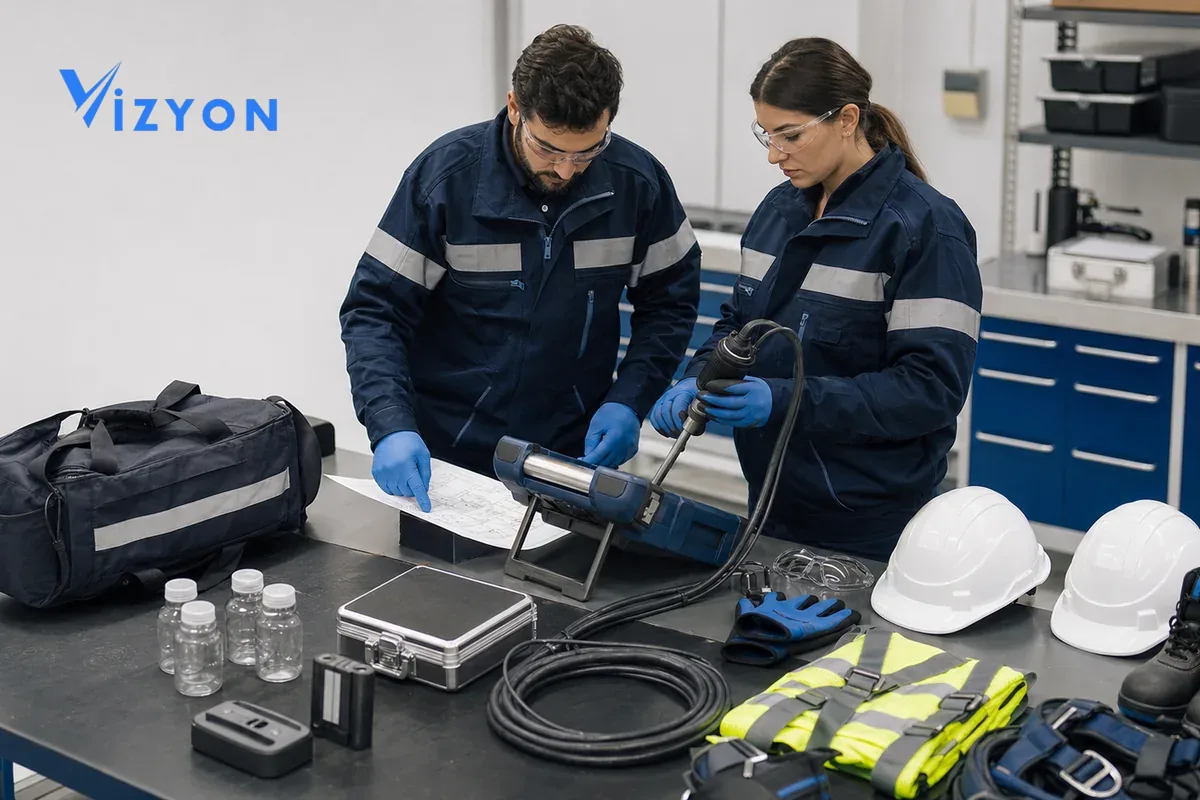
How is the instrument and consumables set checked?
Short answer: Each instrument must be evaluated as a set with its unique identity, suitability for the method and measurement range, calibration/maintenance status, field verification and the accessories to be used with it.
An analyzer appearing “active” in inventory does not mean it is suitable for every parameter and field condition. The plan should cover, alongside the analyzer, the probe, the sampling line, filters and moisture management, flow or velocity equipment, temperature and pressure auxiliaries, connections, power supply, reference/quality control materials and the necessary consumables. The manufacturer's instructions and the organization's controlled method must be applied without contradiction.
The technical counterpart of the ISO/IEC 17025 framework is to preserve the suitability of equipment affecting the result and the integrity of records. In software terms, this means blocking the assignment if the instrument's identity, status and validity evidence do not match the job date, and tracking field spare device changes with justification and approval.
- Match the instrument identity, manufacturer/model information and measurement range with the method.
- Verify the calibration, maintenance, fault and intermediate check status on the job date.
- Count the probe, hose, connections, filter, consumables, power and data recording components as one set.
- Record the pre-field zero/span or the verification required by the method on a controlled form.
- Determine the spare instrument and consumables plan; block automatic report publishing on unplanned changes.
How is work at height and field safety managed fail-closed?
Short answer: Unless safe access, a protected platform, field permits, weather and process risks and the rescue arrangement are verified, the team must not start work just because PPE is available.
The Ministry of Labour and Social Security's work-at-height guideline addresses eliminating the hazard and collective protection before personal protection in the hierarchy of controls. Applied to the stack plan, the first preference is a working platform with safe access and edge protection. If a fall arrest system is required, the suitable anchor, connection, training and rescue plan are evaluated together; a photograph of a safety harness is not sufficient evidence on its own.
The field plan should include the facility's work permit, orientation, area classification, hot surfaces, pressurized or hot gas, electricity, weather conditions, lighting, lifting/carrying, falling objects and emergency communication. A risk assessment does not replace the authorized occupational safety arrangement; the software only keeps the verification steps and evidence visible.
- Verify the access ladder, platform, railing, ground and the area around the sampling port with survey evidence.
- Link the required work permit, facility isolation and process responsible approval to the job.
- Check the helmet, goggles, gloves, reflective clothing, safety footwear and other job-specific PPE.
- Define air limits, shift duration, communication and emergency/responsible persons.
- Explicitly give the team leader the authority to stop the job if conditions change, and record the event.
How are planned and actual compared in the field?
Short answer: At the start, the stack identity, process, team, instruments and safety conditions are re-confirmed; each deviation becomes a separate record linked to the result.
On platforms with weak internet, the offline form must securely carry the assigned job and the controlled method. The actual start-end time, process status, environmental conditions, instrument verifications, raw records, photographs and sample identities are linked to the job file. Synchronization must not silently overwrite old data; it must check conflicts and time stamps.
In jobs where samples are taken, the container or filter identity, the person handing over and receiving, the time and laboratory acceptance are tracked. The software does not replace the physical sample or the technical decision; it protects the chain of evidence formed by the correct stack, personnel, instruments and method.
Which status gates should a digital field plan have?
Short answer: Draft, technical check, safety check, ready for field, in field, technical review and report closure must be separated from each other.
| Gate | Mandatory evidence | System behavior |
|---|---|---|
| Technical scope | Stack identity, parameter, method/version, sampling plane, process condition | If missing, block team assignment |
| Team and instruments | Role-competency match, instrument/consumables set and validity | Prevent unsuitable assignment |
| Safety | Access, platform, permits, risk control, PPE and emergency arrangement | Close the field-ready status |
| Field closure | Actual team/instruments, process, raw record, deviations and sample chain | If missing, close technical review |
| Report | Calculation, review, version and approval trail | If missing, block publication |
You can review the current scope of the Vizyon Baca solution ; and to additionally analyze the method, authorization and official system requirements for your emission laboratory workflow, You can contact VizyonTech. The software does not provide laboratory authorization or a guarantee of regulatory compliance; it supports a verified workflow.
Sources
- 2025 Measurement, Sampling and Reporting Trainings, 4 November 2025 — Ministry of Environment, Urbanization and Climate Change
- ISO/IEC 17025:2017, third edition; reaffirmed in 2023 — International Organization for Standardization
- Method 1 — Sample and Velocity Traverses for Stationary Sources; page updated 23 February 2026 — U.S. EPA
- EMC Promulgated Test Methods; index of methods and quality control lists — U.S. EPA
- Working at Height: responsibilities and hierarchy of controls — Republic of Türkiye Ministry of Labour and Social Security
- Health and Safety in the Use of Work Equipment — Republic of Türkiye Ministry of Labour and Social Security